1. Executive Purpose & Strategic Rationale
Corporate spinoffs are among the most complex, high-stakes events in public equity markets. Because these transactions represent a complete restructuring of assets, liabilities, and corporate governance, they cannot be evaluated using traditional, backward-looking financial screening tools.
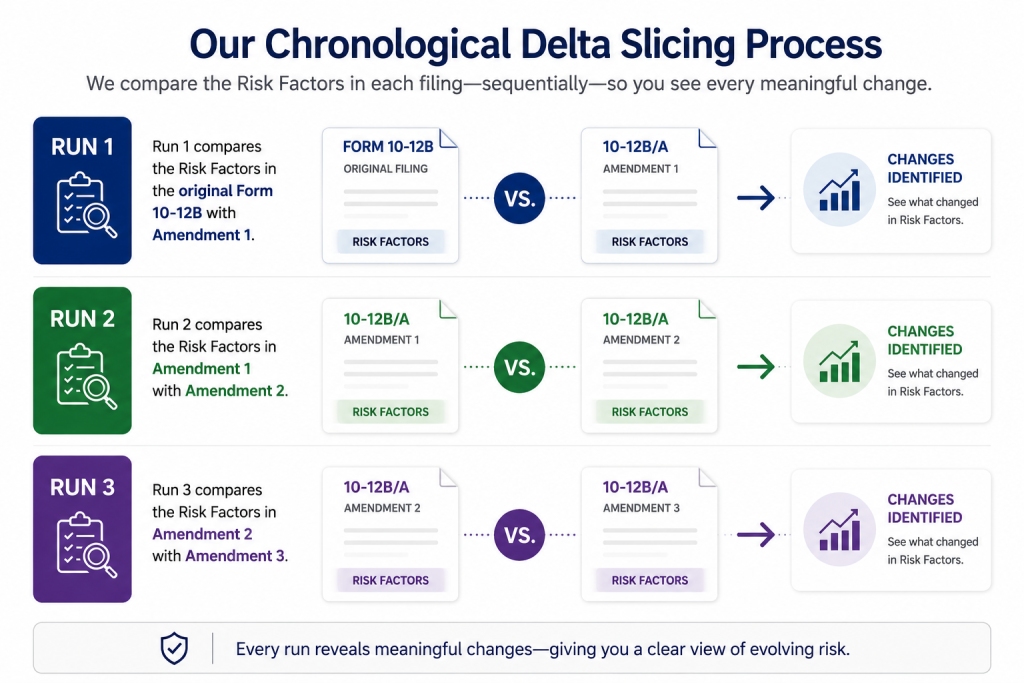
When a parent company files an initial registration statement (Form 10-12B), it is frequently a skeleton placeholder. The critical operational details—such as finalized debt covenants, transitional services pricing, parent-retained equity overhangs, and tax indemnification boundaries—are quietly filled in across consecutive amendments (Form 10-12B/A) and associated Information Statements (Exhibit 99.1).
The “Overlooked Delta” Blind Spot
Standard institutional research processes suffer from a severe structural blind spot. Financial databases typically overwrite previous filings, preserving only the “current” state of a document. Analysts attempting to perform delta analysis are forced to manually compare thousands of pages of dense, highly repetitive legal prose across multiple draft iterations of Exhibit 99.1 Information Statements.
2. Real-World Business Cases: The Forensic Evidence
The model’s value is demonstrated across five distinct spinoff transactions, uncovering critical risk indicators that would have easily bypassed standard quantitative screens:
Case A: ADI Global Distribution (ADIG) — Tracing Leverage Creep
- The Run 2 vs. Run 3 Delta: Comparing the Second and Third Amendments revealed a quiet $100 million escalation in the Term Loan (stepping up from $500 million to $600 million), pushing total funded starting debt to $1.0 billion (3.14x Adjusted EBITDA) to fund a cash dividend back to the parent, Resideo (REZI).
- The Governance Gem: Run 3 successfully captured the transition where the CD&R Group’s preferred voting power placeholder was finalized at exactly 19.69% with two dedicated board seats, allowing analysts to accurately model minority shareholder discount risks weeks before trading opened.
Case B: Honeywell Aerospace (HONA) — Unmasking Carve-Out Accounting
- The Run 1 Delta: Identified that while historical segment earnings showed a highly profitable segment, the standalone pro forma adjustments revealed a 46% collapse in Net Income (from $2,687 million down to $1,444 million).
- The Insight: The model flagged that nearly half of the segment’s profitability was instantly vaporized by $859 million in new interest expenses and $631 million in standalone corporate overhead. This proved the danger of valuing the company based on legacy parent segment reporting.
Case C: Midera Food Processing (MFP) — Identifying Opportunistic Entry Points
- The Delta: Detected a highly unusual, positive financial de-risking event. The planned post-spin debt load was reduced by -$26.5 million and the cash extraction dividend back to the parent, Middleby, fell by -$27 million.
- The Insight: The model instantly flagged this as a potential green light for equity investors, signaling either conservative financial policy adjustments or superior pre-spin cash generation by the subsidiary.
Case D: Mobility Global (MBGL) — Catching Covenant Ceilings
- The Delta: Captured the shift from completely un-priced, vague debt intentions to three concrete tranches of senior notes totaling $2.0 billion and, crucially, the late-stage introduction of a 3.50x net leverage covenant limit.
- The Insight: This structural change gave credit analysts a definitive ceiling to model, mapping out the exact margin contraction threshold that would trigger a default event post-separation.
Case E: FedEx Freight (FDXF) — Mapping Major De-Risking Events
- The Delta: Identified a crucial legal transition where the spin-off’s tax-free status shifted from being dependent on a “written legal opinion from Skadden” to having received a formal Private Letter Ruling (PLR) from the IRS.
- The Insight: A PLR provides a near-bulletproof layer of tax certainty, fundamentally reducing the catastrophic contingent liability risk of a multi-billion dollar retroactive tax-sharing indemnity.
3. How the Model Achieves the Ultimate Research Goal
This engine was built to achieve three core investment research objectives:
I. Support Ongoing Learning about Corporate Events
By institutionalizing the tracking of amendments, the model acts as an interactive repository of corporate behavior. Users learn exactly how corporate parents balance capital structure, how private equity firms (like CD&R in ADIG ) negotiate minority voting rights, and how Transitional Services Agreements (TSAs) are structured to protect margins.
II. Improve Institutional Decision-Making
Instead of relying on late-stage marketing decks or broker summaries, investment committees can base their underwriting decisions on the exact legal and quantitative changes made in SEC filings. For example, knowing that ADIG carries a dual-layered tax indemnity obligation to both Resideo and Honeywell provides a definitive risk boundary for stress-testing cash flows.
III. Identify Meaningful Changes & Overlooked Insights
The model automatically flags subtle shifts in legal wording that humans easily miss. Examples include catching when a parent company increases a post-separation trademark royalty fee, or when an environmental liability indemnity caps its parent reimbursement obligation. These “micro-edits” can represent tens of millions of dollars in unexpected standalone expenses.
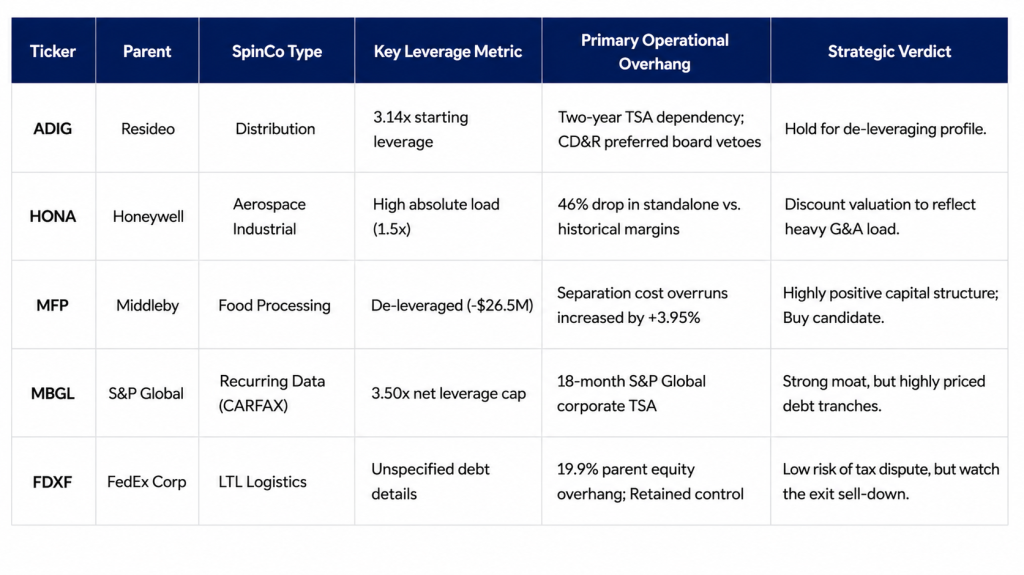
4. Summary Matrix of Transaction Types
READY TO MOVE BEYOND THIS CASE?